
Imagine you’re looking for a new laptop. Instead of typing “laptop under €1,500,” you ask Google a much more specific question: “Which laptop is suitable for graphic design, video editing, and everyday use without being too heavy?” You get an answer, compare a few options, then continue the conversation with another question: “And which of these models has the best battery life?” It’s exactly in situations like these that Google is beginning to develop the next generation of search ads.
On October 28, 2026, Google announced that ads in AI Mode would expand to 10 new markets, along with the introduction of ads in follow-up questions in the United States. This matters not just because a new ad placement is being introduced. It shows how Google is adapting its advertising model for users who increasingly search for information through conversations, comparisons, and follow-up questions. For businesses, this raises several important questions. What will ads look like in the future of Google Search? Will keywords continue to matter as much? What will change in Google Ads campaigns? And, above all, what does all this mean for companies in Bulgaria?
1. What Is Google AI Mode, and Why Is It Changing the Way People Search?
Google AI Mode is a search experience that lets users ask complex questions, get AI-generated answers, and continue the conversation with follow-up questions. Traditional searches usually start with a specific keyword or short phrase, such as “air conditioners Varna,” “accounting services,” or “best phone.” AI Mode lets users express the same search as a much more detailed query.
A user might type: “I’m looking for an air conditioner for a 35-square-meter room that faces south, and I want to compare models with low electricity consumption.” This isn’t just a longer keyword phrase. The question includes a specific need, conditions, limitations, and selection criteria. AI can use this context to organize the answer in a way that helps the user explore their options.
From keywords to real user intent
In traditional Google Search advertising, keywords, intent signals, campaign settings, and the ad auction all play a central role. AI Mode introduces an additional possibility: the ad system can take into account the context of a longer information-seeking journey. The difference can be seen in three situations:Informational search: the user wants to understand how a product or service works.Comparison shopping: the user is exploring different solutions and weighing their benefits.Purchase intent: the user starts looking for a specific provider, price, or purchase option.These stages don’t always follow a strict sequence.
One person may go from research to purchase in a single conversation, while another may compare options for days.
For advertisers, the key shift is the potential to connect ads not only to the exact words people type, but also to the broader context of their needs.This doesn’t mean keywords are disappearing. It means that strategies for reaching potential customers will increasingly need to account for how they phrase their questions.
2. What exactly did Google announce on October 28, 2026?
In the official post Ads in AI Mode expand to new markets, Shashi Thakur, Vice President and General Manager of Google Search Ads, outlines several important developments. The first is the geographic expansion of ads in AI Mode. Google announced their rollout in the following countries: Australia, Canada, India, Kenya, Malaysia, New Zealand, Nigeria, Pakistan, the Philippines, and Singapore. The company also noted plans for further expansion in the final quarter of 2026, including Brazil, Mexico, and the United Kingdom.
It’s important to distinguish between an announced rollout and a planned future expansion. A country appearing in Google’s plans doesn’t automatically mean that all ad formats are already available there. The second major announcement concerns the United States. Google announced the introduction of so-called multiturn ads, or ads that appear in follow-up questions within an AI Mode conversation. The third development is the continued evolution of ad formats. Google says it will experiment with different ways of presenting ads, while ensuring that sponsored content remains clearly labeled “Sponsored.”
This distinction matters because AI Mode combines AI-generated answers, information sources, and potential commercial offers.Paid advertising and organic AI responses are not the same thing. According to Google’s official documentation, advertisers cannot pay to directly influence AI-generated organic responses.
What hasn’t been announced?
The published news contains no confirmation that ads in AI Mode are launching in Bulgaria. Nor does it present universal results showing increased sales, lower advertising costs, or improved return on investment. This is an important clarification: the expansion of an advertising product does not prove its effectiveness for every industry or market.
The main takeaway: Google is expanding the geographic reach of ads in AI Mode and experimenting with ad formats that follow the flow of a user’s conversation. This marks a new stage in the platform’s development, but it is not a basis for promising automatically better advertising results.
3. Why is Google paying so much attention to conversational searches?
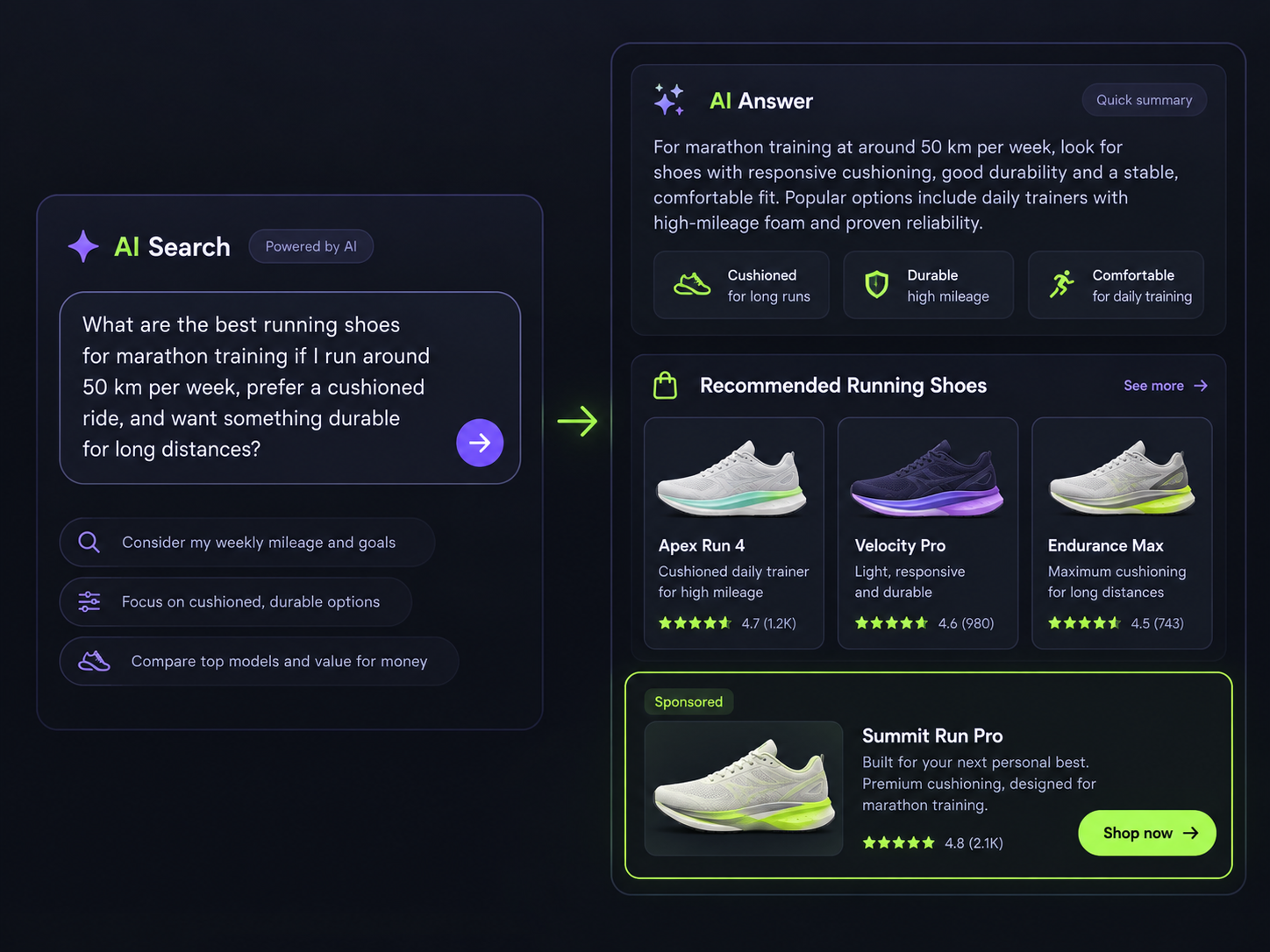
One of the most interesting statistics in Google’s post concerns the length of user queries. According to Google, searches in AI Mode are three times longer on average than traditional searches. The source cited is the Google AI Mode Report for the United States from May 2026. This information points to an important shift in user behavior: when an interface allows for conversational interaction, people can describe their needs in more detail. Instead of adapting their question to the search engine, they can explain exactly what they want.
What do queries that are three times longer mean?
Let’s look at two example scenarios. In a traditional search, someone might use the phrase “hotel with a spa.” In a conversational search, they might ask: “Which hotel with an indoor pool and spa area is suitable for a romantic weekend, offers late checkout, and is no more than a three-hour drive away?” The second search contains significantly more information about the customer’s preferences. For the hotel, this could mean an opportunity to reach a user whose preferences are already clearly defined. The same logic applies to B2B services. Instead of searching for “marketing agency,” a user might ask: “How can I find an agency that manages Google Ads, tracks actual inquiries, and works with a limited monthly budget?” This is a qualitatively different context. The user is already describing a specific problem and their expectations for a solution.
A longer search does not necessarily mean greater purchase readiness
It’s important not to jump to conclusions here. Query length alone does not prove stronger purchase intent. Someone might ask a complex question out of curiosity, with no intention of buying anything. Another person might enter just two words and place an order immediately. That’s why understanding context should be combined with other signals: user behavior, the relevance of the offer, the conditions of the ad auction, and the quality of the landing page. The official announcement also does not provide enough detail about the sample and methodology to apply statistics from the U.S. market directly to the behavior of Bulgarian users. A search that is three times longer is an interesting indicator of how the interface is evolving, but it is not a forecast of three times as many customers.
4. Multiturn ads: ads can now appear in follow-up questions
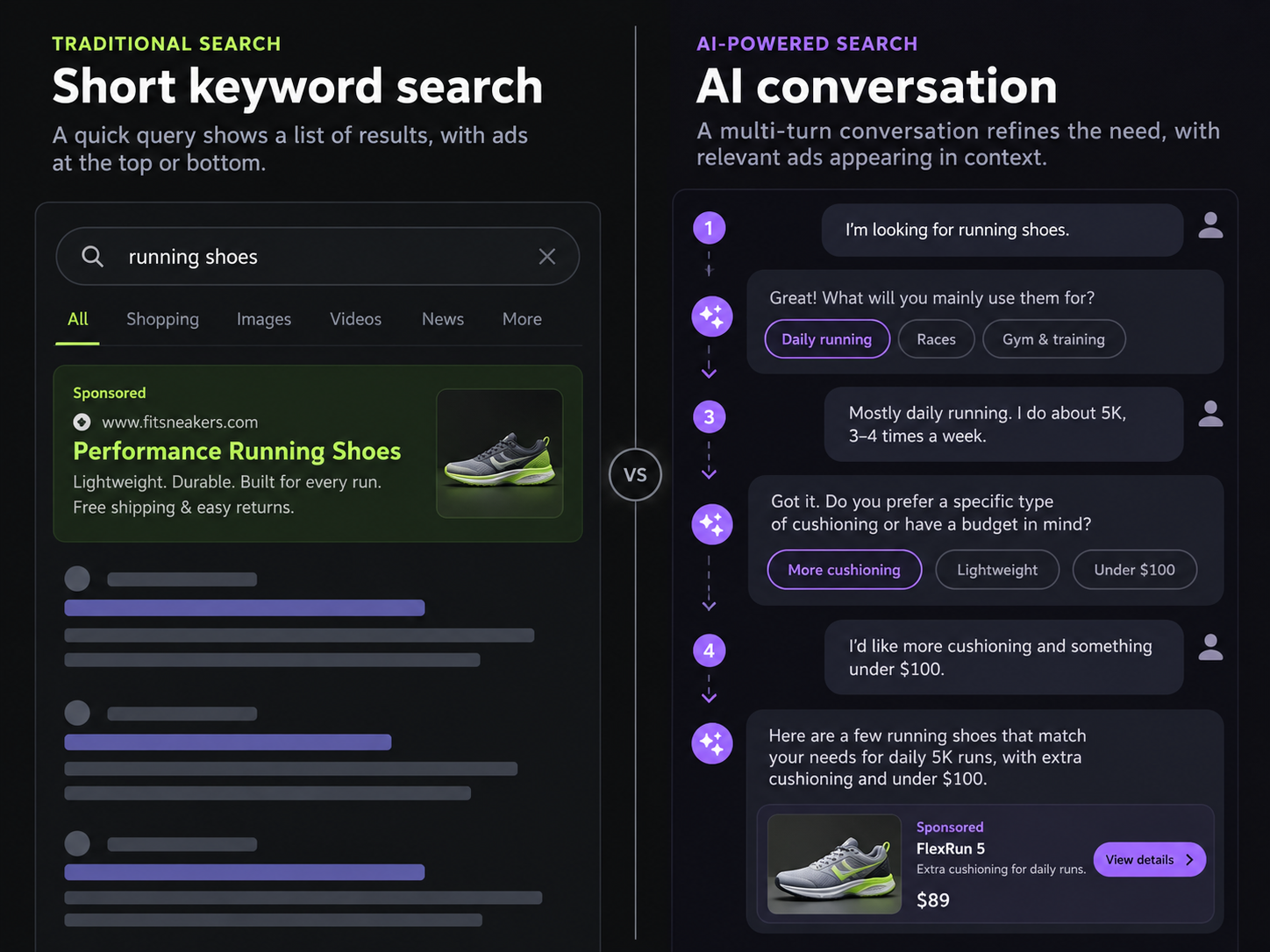
One of the most significant developments is the introduction of ads in follow-up questions in AI Mode in the U.S.These ads are called multiturn ads.To understand why they matter, we need to look at how a conversation with AI unfolds. A user starts with an initial question. After receiving an answer, they may ask a follow-up question to refine their criteria. For example: “What type of mattress is suitable for different firmness preferences?” “What materials are used in higher-end mattresses?” “Which models are available in 160 x 200 cm?” “Where can I compare prices and delivery terms?” The initial conversation is primarily informational. With each subsequent step, however, clearer commercial intent may emerge. This is where the new format becomes interesting. The ad system can show relevant sponsored content in the context of follow-up questions, rather than limiting advertising opportunities to the initial query.
What is changing for advertisers? In traditional Search campaigns, advertising is generally viewed through the lens of individual searches and the intent behind them. The conversational model adds the ability to recognize commercial context as it develops over time. This could be especially interesting for businesses where customers don’t make decisions right away, such as: High-value products that require comparison. Specialized services where customers need to understand the process. B2B solutions with longer decision-making cycles. Online stores with a wide range of products. Services where trust and expertise play a significant role. However, it’s important not to treat these possibilities as proven results. These are business scenarios where contextual advertising could have a role. Actual performance will depend on the specific campaigns, audiences, markets, and serving conditions.
5. How does Google decide which ads appear in AI Mode?
According to Google’s official documentation on ads in AI Search, the system can use different approaches to match ads with users’ needs. One approach is based on direct commercial intent. If a user searches for a specific product, an ad may be matched to their query. The other approach is contextual. In this case, the system may take into account both the user’s question and the context of the AI-generated answer. This expands the opportunities to find relevant ad offerings for more exploratory searches.
Direct matching
Imagine a user asking: “Where can I buy a robot vacuum with a mopping function?” The purchase intent is relatively clear. The system may use this intent to match the query with suitable ads, based on the available advertising campaigns and auction conditions. Contextual matching
Now imagine the question: “How can I keep my floors clean if I have pets and don’t have time to clean every day?” The initial question doesn’t specifically mention a robot vacuum. But if the answer explores different ways to automate cleaning, it may create context for a relevant product. Google describes this kind of contextual matching as part of the advertising opportunities in AI Search. This doesn’t mean an ad will necessarily appear in response to every similar question. Ad serving still depends on relevance, eligibility, available campaigns, and other factors.
What role do different campaign types play?
The official documentation notes that existing Search, Shopping, and Performance Max campaigns may be eligible for ad placements in AI Mode where the relevant features are available. This has a practical implication for advertisers: they don’t necessarily need to build an entirely new campaign specifically for AI Mode. At the same time, Google says advertisers can’t target their campaigns exclusively to AI Mode or exclude this type of placement separately from Search. So, advertisers don’t have the same control as they would when choosing a standalone advertising channel. This is an important detail when planning budgets, measurement, and expectations.
6. What does Google’s data show about ad performance?
In addition to sharing information about longer queries, Google has also reported on how users interact with advertising offers. According to the company, click-through rates for sponsored and organic product listings in AI Mode are now at similar levels in the observations it cited. The source is Google’s internal data for the United States, covering the period from August 20 to September 3, 2026. At first glance, this is an encouraging signal for advertisers. If users interact with sponsored product listings in much the same way as they do with organic listings, the ad format could be seen as a useful part of the decision-making process. But there are several important limitations.
What does CTR actually measure?
CTR, or click-through rate, is the ratio of clicks to impressions. For example, 50 clicks from 1,000 impressions gives a CTR of 5%. This metric measures interaction, but it does not measure profit on its own. Two ad formats can have similar CTRs but deliver significantly different results in terms of sales, order value, or customer acquisition cost. One format may attract more people who are still exploring their options. Another may reach users who are already ready to buy. Clicks matter in both cases, but they do not necessarily have the same business value.
Why can’t we declare AI Mode more effective?
The brief announcement does not publicly provide all the details needed for an independent comparison. There is not enough information about: the size and selection of the sample analyzed; the specific product categories; the exact CTR figures; differences across devices and audiences; subsequent conversions and actual purchases; or customer acquisition cost and return on advertising investment. The data is also from the US market. These limitations do not make Google’s observations irrelevant. They simply define what we can and cannot conclude from them.
7. What does the development of AI Mode mean for businesses in Bulgaria?
For companies in Bulgaria, the key question is not whether Google is developing new ad formats, but when and under what conditions they can be used in the local market. As of October 29, 2026, the official announcement in question does not include Bulgaria among the countries where Google says it is expanding ads in AI Mode. It would therefore be inaccurate to claim that every Bulgarian advertiser can already use the new ad placements to reach audiences in Bulgaria. We should also distinguish between several different situations. The first is a business that advertises exclusively in the Bulgarian market. The second is a Bulgarian company that sells products or services in international markets. The third is a company that already runs Google Ads campaigns in countries where the new advertising options are available. These situations should not be treated as identical.
Bulgarian businesses with international customers
A company selling in markets such as the US, Canada or Australia has reason to pay closer attention to the development of AI ads. If it uses eligible campaigns, advertises in a supported language and meets the other requirements, its ads may be eligible to participate in the relevant ad auctions. However, this does not guarantee impressions or a specific placement. Geographic targeting, ad settings, available inventory, product type and relevance still matter.
Businesses operating only in Bulgaria
For local companies, preparation is a more sensible approach than hastily reallocating their budgets. There is no reason to pause effective Search campaigns simply because Google is experimenting with new AI formats. Instead, businesses can improve several aspects of their existing digital presence. These include website structure, the quality of product descriptions, conversion tracking, ad copy and the clarity of the information they provide. These improvements are valuable beyond AI Mode, too. Well-structured pages make things easier for users, reduce uncertainty and create better conditions for evaluating ad performance. This means businesses can start preparing for future changes to advertising even before a particular format becomes available in the local market.
8. How can businesses prepare their Google Ads strategy?
Changes in search do not mean that every advertising strategy needs to be rebuilt from scratch. Rather, they place greater emphasis on the quality of the input data and a business’s ability to understand different user intents. Google already outlines several key practices in its documentation on AI ad experiences. 1. Improve conversion tracking Before investing in new advertising opportunities, businesses need to be clear about what counts as a real result. For an online store, this might be a completed purchase. For a service provider, it could be a qualified inquiry, a scheduled meeting or a confirmed order. It is essential to track events accurately and not treat secondary interactions as equivalent to primary business goals. If the system counts every button click as an equal conversion, optimization may focus on actions that do not deliver real value. That is why quality tracking is not just a technical task. It is the foundation for sound management decisions.
2. Analyze the questions users actually ask When people search conversationally, it becomes even more important for companies to understand the questions customers ask before making a purchase. Useful sources include: Frequently asked questions directed to the sales team. Conversations with prospective customers. Reasons customers decide not to buy. Common objections about price or quality. Questions about delivery, warranties and terms. The words customers actually use to describe their problem. This information can be used both in website content and when developing ad copy. For example, a business selling office furniture may find that customers care not only about price, but also about ergonomics, warranties, delivery times and installation options. Its advertising can then be much more specific.
3. More complete and accurate product information For online stores, Google emphasizes the importance of high-quality product data in Merchant Center. This includes accurate titles, detailed descriptions, up-to-date prices, high-quality images and reliable information about availability, delivery and returns. When a product is described incompletely or inaccurately, users may have difficulty comparing options. Another problem arises when the information in the product feed does not match what is on the website. Product data management should therefore be part of the overall advertising strategy, not just an administrative task.
4. Clearer landing pages If an ad addresses a specific need, the landing page should follow the same logic. Consider a company that builds websites. A user is looking for a solution for an online store with integrated payments and automated order processing. If the ad takes them to a generic page with the vague message “We create digital solutions,” it may not answer their questions well enough. A page that presents specific features, the work process, limitations, and next steps would be far more useful. This doesn’t mean every page needs to be as long as possible. It means the information should be relevant, clear, and sufficient for that stage of the decision-making process.
5. Using automated targeting carefully Google describes AI Max for Search, broad match, Shopping, and Performance Max as capabilities that can contribute to different ad-matching mechanisms. But automation doesn’t eliminate the need for oversight. Advertisers remain responsible for data quality, advertising goals, budget, constraints, and performance analysis. Broader targeting can create opportunities to reach new users, but it can also increase spending on interactions that don’t lead to the desired results. That’s why changes should be introduced gradually, with clear evaluation criteria. For companies looking to build a similar approach, professional Google Ads campaign management by Trendcodd can include an analysis of the advertising structure, tracking, and the quality of the user journey.
9. AI Mode and SEO: Will the Importance of Content Change?
The rise of AI search raises important questions for SEO strategies, too. As users ask detailed questions, companies need to consider whether their content genuinely addresses their audience’s specific needs. The traditional approach of creating a page primarily around a single keyword is often not enough to cover a complex topic. For example, an article titled “What Is Google Ads?” may be useful for beginners. But a business owner who already uses the platform is likely to have different questions: how to assess lead quality, improve measurement, or determine whether advertising is generating actual sales. These questions call for more in-depth content. Expertise becomes part of the value for users Content that merely repeats widely known definitions is unlikely to help a reader looking for a specific solution. A useful article should explain the context, distinguish between different situations, and point out the limitations of the advice it offers. This is especially true of topics related to automation, algorithms, and advertising technology. When platforms announce new features, it can be tempting to present every change as revolutionary. But for businesses, the value lies in understanding when a technology is applicable and what they can realistically expect from it. Another point matters, too: ads in AI Mode and organic visibility in AI responses are separate mechanisms. Improving a website doesn’t guarantee a specific ad placement, and buying an ad doesn’t secure an organic citation in an AI response. A good SEO strategy remains focused on useful content, clear structure, technical accessibility, and genuine value for the audience.
10. What should we watch in the coming months?
The expansion of AI Mode raises several important topics that deserve further analysis. The first is geographic availability. It’s important to track not just where Google offers AI features, but specifically where ads in AI Mode are available, in which languages, and under what conditions. The second is measurement transparency. Google says that ad metrics from AI experiences are included in standard reports for eligible campaigns. However, this doesn’t necessarily mean advertisers can isolate and analyze all AI Mode results as a standalone advertising channel. This limitation matters when trying to determine whether the new format is more effective than traditional search. The third topic is the evolution of ad formats. Ad presentation may change as Google continues its experiments. For this reason, specific visual examples and features should be considered in the context of the date, market, and official documentation. The fourth topic is user behavior. Longer queries are only one part of the picture. Advertisers will want to know whether conversational search leads to better-informed decisions, different interaction patterns, and measurable business value. The fifth topic is the need for better content. If search is evolving toward more specific questions, businesses have reason to improve their service descriptions, product information, and answers to frequently asked questions. This is a worthwhile direction regardless of whether a company uses AI ad formats today.
Are ads in Google AI Mode available in Bulgaria?
As of October 29, 2026, Bulgaria is not included in the officially announced list of new markets for ads in AI Mode. Availability may change and should be checked against Google’s latest documentation.
Do I need a separate Google Ads campaign for AI Mode?
According to Google’s documentation, existing eligible Search, Shopping, and Performance Max campaigns can participate in ad auctions in AI Mode. A separate budget for this format is not required.
Will traditional keywords disappear?
There’s no basis for that conclusion. Keywords still play a role, while contextual matching creates additional ways to reach users.
Is your business ready for the next generation of digital advertising?
If you’d like to find out whether your current Google Ads campaigns are using their budget effectively and where there’s room for improvement, we can start by analyzing your current advertising presence.
Contact us