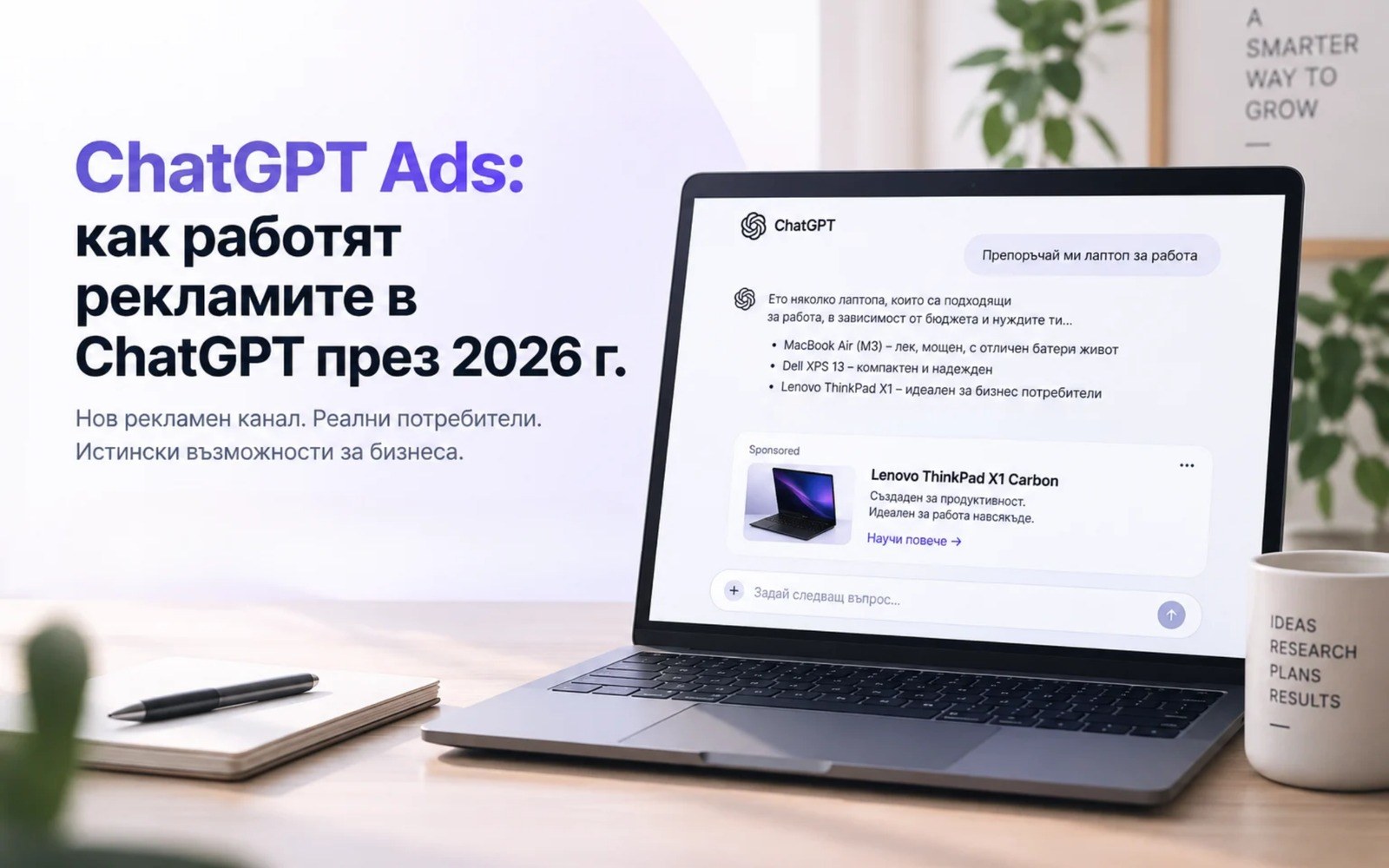
The difference is significant. Users do not always enter a short query consisting of two or three words. In a conversation with ChatGPT, they can explain their situation in detail: what the problem is, what they have already tried, what budget they have, what limitations exist and what result they expect. This creates much richer context around their intent.
This changes both the way targeting works and the logic behind the advertising message.
In August 2026, OpenAI expanded ChatGPT Ads to 31 European markets, and on August 31, self-service access through Ads Manager was also activated for these markets. As of September 7, Bulgaria is officially listed as a country where self-service Ads Manager is available.
At the same time, the advertising ecosystem itself continues to grow. On August 31, OpenAI announced that in less than 200 days, ChatGPT Ads had reached $1 billion in annualized revenue run rate, the platform was already being used by tens of thousands of advertisers, and ChatGPT had more than 1 billion weekly active users.
This does not mean that every business should automatically move its advertising budget from Google or Meta to ChatGPT. It means that a new advertising channel is taking shape, with sufficient scale, a different user environment and its own operating model—one that now deserves serious attention.
In short: ChatGPT Ads are sponsored ad units displayed separately from ChatGPT’s responses. Their selection takes into account relevance, intent within the conversation, the advertising message, the landing page and other signals. The ads themselves do not determine what ChatGPT will answer.

1. What are ChatGPT Ads and why does the topic matter right now?
ChatGPT Ads are sponsored advertising offers displayed in ChatGPT, giving businesses the opportunity to reach users at a moment when they are already researching a topic, comparing options or making a decision. This is a different environment from casually scrolling through a social network. For example, someone might ask:
“Which CRM system is suitable for a small team?”But they might also write:“We have five people on our sales team, receive inquiries from Facebook, our website and the phone, and constantly lose track of where each customer is in the process. How can we organize this?”
The second formulation contains much more information about the user’s actual need. This is where one of the most interesting features of ads in ChatGPT emerges: the system can consider the context and intent within the current conversation, rather than relying solely on an individual query.
For advertisers, this means a shift in the way they think. Instead of only asking: “Which keywords do we want to appear for?” it becomes important to ask: “In what situations could our product or service be useful?”
This places greater emphasis on understanding the audience, its real problems and the context in which the need for a solution arises.
In standard search, users often enter a short query such as “CRM for small business,” “good hotel in Vienna,” or “English course.” In a conversation with ChatGPT, the same person may provide much more information: how many people are on their team, what budget they have, what problem they are trying to solve, what they have already tried, and which conditions matter to them.
This additional context is precisely one of the most interesting features of ChatGPT Ads. The system can consider intent within the context of the ongoing conversation, rather than looking only at an individual query, to assess whether a particular advertising offer is relevant.
The scale of this new advertising channel is already significant. Data published by OpenAI on August 31, 2026, highlights three metrics worth noting:
What weak pages usually get wrong
2. Ads in ChatGPT: what they look like and where they appear
Ads appear below ChatGPT’s responses and are visually separated from the main conversation content. This is a core principle of the system—the user must be able to clearly distinguish ChatGPT’s response from paid advertising content.
According to the current documentation, an ad unit may contain: advertiser name; favicon or logo; headline; ad description; landing page; image.
This looks relatively familiar, but the context in which the ad appears is different.
The user is already having a conversation and has a specific goal. The ad should therefore complement that moment, rather than simply interrupting it with a random promotional message.
OpenAI lists answer independence among the platform’s core principles. This means that an advertiser cannot pay to change ChatGPT’s answer, make the assistant recommend a specific product, or push a competing offer out of the answer itself.
Who can see ads At present, ads may be shown to users on Free and Go plans. Plus, Pro, Business, Enterprise, and Edu plans remain ad-free. OpenAI also states that ads are not shown to accounts identified as belonging to people under 18. For the visual cards in this section, you can use:
The format itself is relatively clean and clearly distinct from ChatGPT’s response. At present, the official documentation outlines several specific characteristics of the advertising experience:
6key elements Advertiser name, logo, headline, description, landing page, and image may all be part of a single ad unit. 2plans with adsAds may be shown to users on Free and Go plans.5AD-FREE PLANSPlus, Pro, Business, Enterprise, and Edu remain free of ad units.
Users on Plus, Pro, Business, Enterprise, and Edu plans currently do not see ads. However, it is important to emphasize that having a Free or Go plan does not mean an ad will necessarily appear after every response. The advertising system decides when and which ad to show based on expected relevance and performance.
For businesses, this means the ad itself needs to be understood quickly. The user already has context. Therefore, a specific promise, a clear practical benefit, and the right landing page may prove far more important than a loud advertising slogan.
WANT TO KEEP UP WITH NEW ADVERTISING CHANNELS BEFORE EVERYONE ELSE?Get practical insights on ChatGPT Ads, Google, Meta, and new opportunities in digital advertising—with specific ideas, examples, and guidance for businesses.
The offer should be specific, easy to understand, and directly connected to the user’s need. OpenAI recommends that ad copy clearly explain what the product offers, who it is intended for, and in what situation it may be useful.
The same logic applies to the image and landing page. The visual should support the message, while the page users reach after clicking should continue the conversation naturally. If the ad promises a specific solution, users should not be sent to a generic homepage and left to search for it themselves.
The takeaway is that the format may look simple, but it is built on a different advertising logic: an ad should not merely attract attention—it should be useful in the exact context in which it appears.
3. How ChatGPT decides which ad to show
The system considers a combination of signals, including: the context of the current conversation; the user’s intent; the landing page; the headline; the ad copy; the context hints provided by the advertiser; when ad personalization is enabled – selected signals from the broader ChatGPT experience.
This means that two very different formulations can point to the same need. For example: “CRM for small businesses” and: “We receive inquiries from five different sources, and some customers are lost because there is no unified process.” The two queries are linguistically different, but the intent behind them may be similar.
Context hints are not just keywords
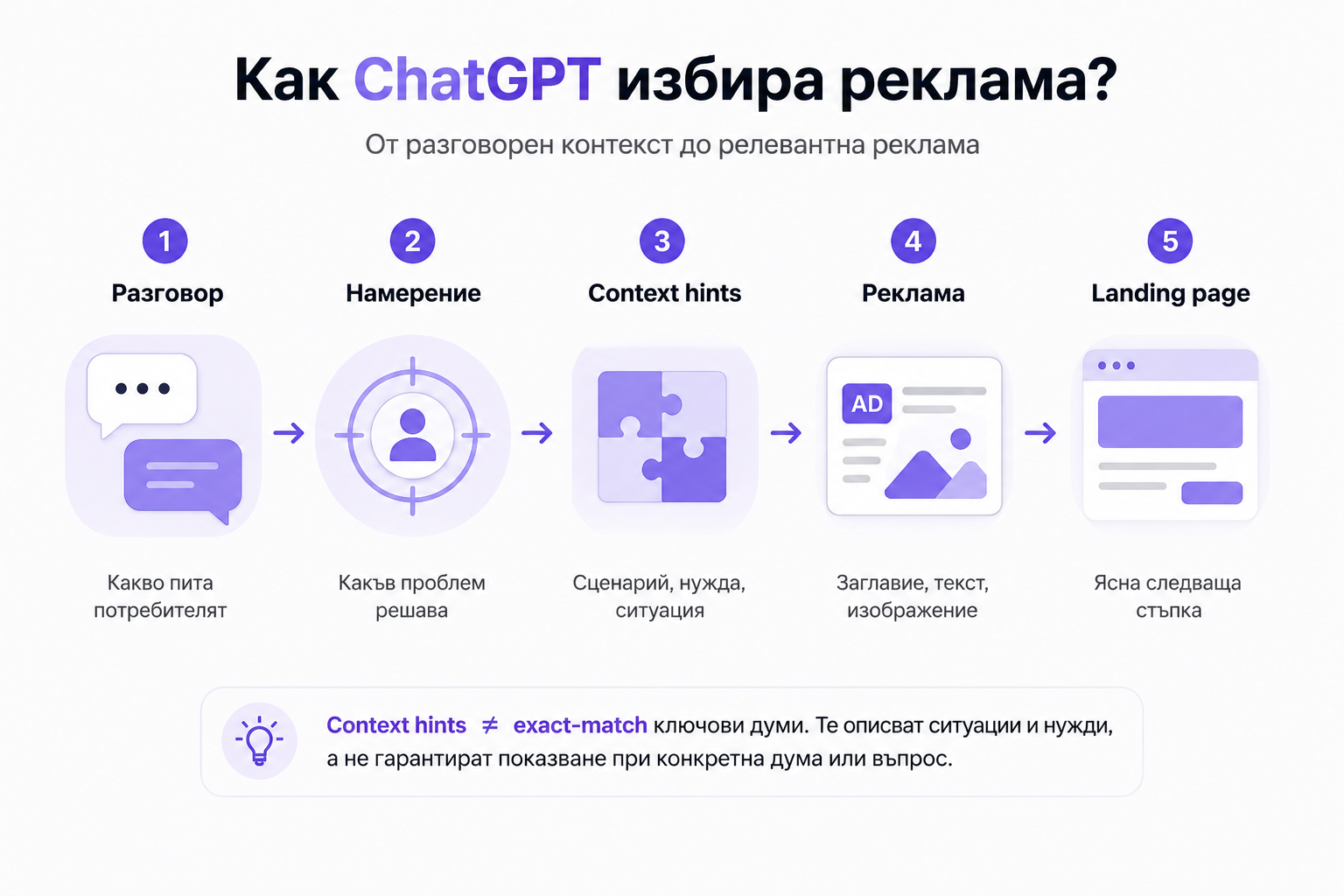
Context hints allow advertisers to describe the conversations, topics, or situations in which their product may be relevant. OpenAI explicitly clarifies that these guidelines are not exact-match keywords and do not guarantee that an ad will be shown for a specific word or conversation. For example, instead of: “running shoes” a more informative hint could be: “cushioned everyday shoes for beginner runners preparing for their first 5K”.
The second version contains: a product; a user; a situation; a real need. In B2B, the same logic might look like this: instead of: “CRM system” one could describe: “small sales teams that receive inquiries through multiple channels and need a unified process for tracking and follow-up communication”. This way, the advertiser starts thinking not only about the terms the customer uses, but also about the real situation behind the search.
Relevance does not end with the conversation
The landing page, ad headline, and description also play a role in the matching system. If an ad promises a specific solution but leads to a generic home page where the user has to search for the service themselves, the logic breaks down. The better path is: Conversation → Intent → Relevant ad → Relevant landing page → Next action
Advertisers need to understand not only the final query a customer might write, but also the questions that come before it:
- How does the person describe their problem?
- What constraints do they have?
- Which alternatives are they comparing?
- What objections do they have?
- What is decisive in their choice?
- What do they need to understand before taking action?
This is especially important for products and services with a longer decision-making process, because a conversation can contain far more signals of intent than a short search query.
Personalized and non-personalized ads
There is another layer as well.
When personalized ads are enabled, ChatGPT may use selected signals from the user’s broader experience, including previous chats and memory, if the relevant settings are active. When personalization is disabled, ads remain based primarily on the current conversation and limited context. However, advertisers do not receive access to the user’s chats, history, or memories.
This is an important distinction: the system can use context for relevance without sharing that context with the advertiser.
Broader coverage instead of one “perfect” ad
OpenAI also recommends a different approach to ad variations. Instead of trying to make a single ad cover every possible situation, advertisers should create a wider range of messages for different needs and scenarios.
One variation might address a specific problem.
Another might target a particular type of customer.
A third might focus on a practical benefit.
A fourth might address a specific use case.
This gives the system more opportunities to identify the right advertising message for different conversations and user intents.
4. How to create a campaign in OpenAI Ads Manager
For those already managing paid advertising in Google Ads, Meta Ads or another performance platform, the structure of OpenAI Ads Manager will look fairly familiar. The core logic is once again built across several levels:
Campaign → Ad Group → Ad
This allows advertisers to separate strategic settings from specific ad messages and test different scenarios without having to build an entirely new campaign for every change.
Campaign: where the strategy begins
At the Campaign level, the main parameters of the advertising activity are defined—the business objective, budget, timeframe and key settings.
This is when the advertiser must clearly answer the question of what they want the campaign to achieve.
If the primary goal is to build greater awareness, the campaign logic will differ from that of driving traffic to a website or generating direct conversions. That is why the choice of campaign objective should not be treated as a technical setting, but as part of the overall marketing strategy.
The budget should also be aligned with the objective. A campaign created to test a new advertising channel does not need to start with a large investment. A more sensible approach is to first collect enough data on audience behavior, ad relevance and traffic quality, then gradually increase the budget.
5. Ad Group: where intent is organized
Ad Group is the level at which ads are grouped around a specific topic, product category, need or intent area.
This is exactly where context hints can be added, giving the system additional information about the type of conversation or user situation in which a particular offer would be relevant.
This is an important distinction from the classic approach of “one ad group = one set of keywords”.
With ChatGPT Ads, it is more useful for advertisers to think in terms of scenarios.
For example, a software product may have different Ad Groups for:
- teams that are losing inquiries;
- businesses looking for automation;
- companies seeking better lead tracking;
- users comparing different CRM solutions.
This way, each Ad Group can have its own context, ad messaging and landing page tailored to the specific need.
Ad: the ad message itself
The specific ad unit is created at the Ad level.
It may include a headline, description, image and destination URL. This is where creative and copywriting come into play.
The Ad level is where the ad that users actually see is created. The headline should communicate value quickly. The description should complement the headline rather than simply repeat it.
The image should support the offer. The landing page should logically continue the promise. OpenAI recommends clear, specific ad copy focused on practical benefits. Rather than abstract slogans, stronger messages clearly explain what the product does, who it is for and when it can be useful.
A best practice is to create several different variants within a single Ad Group.
One can focus on a specific problem.
Another can focus on the outcome.
A third can highlight a particular feature.
A fourth can target a specific type of user.
This gives the system more opportunities to identify which combination of conversational context and ad messaging performs best.
6. What payment models does OpenAI Ads Manager support
With CPM, the primary focus is on reaching more users and increasing ad visibility. This model is more suitable when a business wants to introduce a new product, brand, or offer to a broader audience.
With CPC, the advertiser pays for a valid click. The focus here shifts to a specific action—visiting a website, landing page, or another target page.
oCPC adds another layer. The system uses a predicted probability of conversion and attempts to optimize delivery toward users whose clicks are more likely to lead to the selected action.
For this model to work effectively, conversion tracking must be set up in advance.
Conversion tracking shouldn’t be left until the end
One of the most common mistakes with a new advertising channel is launching the campaign first and setting up measurement later.
This makes analysis more difficult from the very first days.
Before launch, it should be clear what counts as a conversion:
- a submitted form;
- a registration;
- a purchase;
- a consultation request;
- a demo request;
- a subscription;
- another important business action.
When conversion tracking is set up in advance, the advertiser can see not only who clicked the ad, but also what happened after the click. Without this definition, an advertiser may have a high CTR and plenty of traffic, but no real understanding of whether the campaign is contributing to the business.
This is especially important with ChatGPT Ads, because traffic quality may matter more than volume alone.
Don’t look at clicks alone
When evaluating ChatGPT Ads, it makes sense to look at metrics such as: Impressions – how many times the ad was shown. Clicks – how many users moved on to the next step. CTR – the percentage of impressions that resulted in a click. Average CPC – the average cost of a valid click. Average CPM – the cost per 1,000 impressions. Conversions – how many visits led to the desired action. In performance marketing, this final metric is what matters most. An ad can have an excellent CTR and still perform poorly if users take no action after clicking.
7. What should a ChatGPT ad look like
A ChatGPT ad shouldn’t simply copy an existing Meta or Google creative. The context is different. The user has already articulated a need and has probably received information on the subject. That’s why a message such as: “Change the way you work.” may be too generic. A much more informative option would be: “CRM for small teams that want to track inquiries and automate follow-up communication.” The second message makes clear: what the offer is; who it is for; what problem it solves. OpenAI recommends creating more varied ad versions instead of making minimal changes to the same message. The goal is to give the system more opportunities to identify a relevant connection between a specific conversation and a specific ad. One ad might focus on the problem. A second on the outcome. A third on a specific feature. A fourth on a particular type of customer. This is much closer to a strategy built around real user situations.
WANT TO KNOW WHETHER CHATGPT ADS HAVE A PLACE IN YOUR MARKETING?
New advertising channels only make sense when they are part of a clear strategy. We can review your business, goals and current channels to assess where ChatGPT Ads could genuinely add value.
Contact us8. The landing page is part of the ad
The landing page is not simply where someone arrives after clicking. It is one of the signals the advertising system uses to assess relevance. That is why there needs to be a direct connection between: the conversation → the ad → the page If the ad talks about a specific service but leads to a general homepage with dozens of different offerings, the user once again has to search for the solution themselves. This creates unnecessary friction. A stronger landing page: continues the same message; explains the specific value; provides proof; addresses the main objections; has a clear next step. The new advertising channel actually makes a well-structured website even more important. It does not matter how effectively the system finds the right conversation if, after clicking, the user lands on a page that fails to carry their intent forward.
9. Can advertisers see conversations in ChatGPT
This is one of the most important questions surrounding the advertising model. According to OpenAI – no. Advertisers do not get access to: chats; chat history; memories; name; email; exact location; IP address; sensitive information. OpenAI also states that user data is not sold to advertisers. For advertiser reporting, aggregated, non-identifying information about ad performance is provided. This is an important distinction. The system may use information within ChatGPT to determine which ad is relevant. That does not mean the company behind the ad receives the user's conversations.
10. Brand safety and restrictions
Advertising in a conversational AI environment creates different brand safety requirements. OpenAI does not allow ad placements around a range of sensitive or inappropriate conversational contexts. These include topics related to: self-harm; certain health and mental health vulnerabilities; political content; fraud; weapons; illegal activities; regulated products; other sensitive categories. There are also restrictions on the ad categories and assets themselves. At this stage, OpenAI states that ads are primarily aimed at consumer verticals such as lifestyle and household goods, local services, travel and experiences, digital products and education. Some more sensitive categories are handled in a more restricted or case-by-case manner. Businesses should therefore not automatically assume that an ad permitted on Meta or Google will also be allowed on ChatGPT. Ad policies should be reviewed before launch, especially as the platform is evolving rapidly.
11. ChatGPT Ads vs. Google Ads and Meta Ads
The biggest mistake would be to view ChatGPT Ads as a direct “replacement” for Google or Meta. The three channels operate in different user contexts. Google Ads: search Google is extremely strong when the user has already formulated a clear search. For example: “accounting software price” or: “12,000 BTU air conditioner Varna” The intent is often relatively direct. Meta Ads: discovery On Facebook and Instagram, people are not always actively looking for the product. The ad itself can create interest. Here, an important role is played by: creative; behavior; audience; visual hook; retargeting. ChatGPT Ads: conversation In ChatGPT, the user may be somewhere between these two moments. They are not simply searching. They: ask follow-up questions; compare options; explain constraints; clarify their needs; ask for alternatives; look for a solution. This makes conversational intent particularly interesting. But it does not automatically mean it will be more effective for every business. The more useful question is: “Where in our customer journey do ChatGPT Ads fit?” For one business – awareness. For another – consideration. For a third – traffic. For a fourth – conversion.
12. Which businesses could benefit from ChatGPT Ads
The clearest potential lies in categories where users need to research and compare before making a decision. For example: SaaS and digital products; education; travel; local services; certain e-commerce categories; business services, where permitted under current policies. With these types of purchases, users rarely see one image and buy immediately. They ask questions. They compare. They want specifications. They check the price. They look for alternatives. They read the proof. This is precisely where the conversational context can be valuable. But ChatGPT Ads will not compensate for an unclear offer, a weak website or a lack of trust. A new channel does not automatically mean new customers. If users click and do not understand what you offer, the result will be the same as in any other advertising system.
13. How we would approach our first ChatGPT Ads campaign
The first step should not be writing the ad headline. It should be customer research. How does the customer describe the problem? What do they ask before buying? What do they compare? What objections do they have? What constraints do they face? How do they realize they need the product? These questions can be used to define different intent scenarios. Ad Groups and context hints are then built. Different ads can be created for each group. Next comes the landing page. Then – conversion tracking. Only after that does it make sense to launch the campaign. The first test should not be evaluated solely by CTR Monitor: which intent scenarios receive delivery; which ad messages attract attention; which ads drive quality traffic; how users behave on the website; which landing pages perform; how many inquiries or purchases are generated; what the real business result costs. ChatGPT Ads are still a relatively young channel. As a result, advertisers do not yet have the same volume of years of benchmarks, practices and established formulas available for Google and Meta. The first campaign should be a test of hypotheses, not an assumption that the channel will necessarily work.
14. ChatGPT Ads Are Now Available to Advertisers in Bulgaria
For Bulgarian businesses, this is no longer just a topic for the future. As of September 7, 2026, Bulgaria appears on OpenAI’s official list as a market with an available self-service Ads Manager. The legal entity placing the ads and being billed must be based in a country where the self-service service is available. This allows businesses in Bulgaria to start working directly with Ads Manager instead of waiting for a future expansion of the platform. That is precisely why the topic is relevant now. We are not talking about a feature that “may arrive someday.” We are talking about a new advertising channel that can already be tested in practice.
15. What ChatGPT Ads Mean for Marketing in 2026
The biggest change is not the emergence of another place for a banner. The more interesting change is that conversation is becoming an advertising environment. This means advertisers need to understand not only what words a customer searches for, but also: how they think; how they formulate the problem; how they arrive at a solution; what holds them back; what questions they have; what information they need. In this sense, ChatGPT Ads make strong marketing positioning even more important. A brand must be able to answer clearly: What do we offer? Who is it for? What problem do we solve? In which situations are we useful? Why should someone choose us? These questions have always been part of a sound marketing strategy. What is new is that the advertising system itself is now increasingly trying to understand the context surrounding them. ChatGPT Ads do not eliminate the need for Google Ads, Meta Ads, quality content, a good website, or a strong offer. They add another potential channel to the overall system. And that is exactly how they should be viewed.
Are there ads in ChatGPT in 2026?
Yes. ChatGPT Ads now operate as an advertising platform and were expanded to multiple European markets in August 2026.
Are ChatGPT Ads available in Bulgaria?
Yes. As of September 7, 2026, Bulgaria is listed as a market with self-service access to OpenAI Ads Manager
Do ads influence ChatGPT’s responses?
No. OpenAI states that ads are separate from responses and do not influence their content.