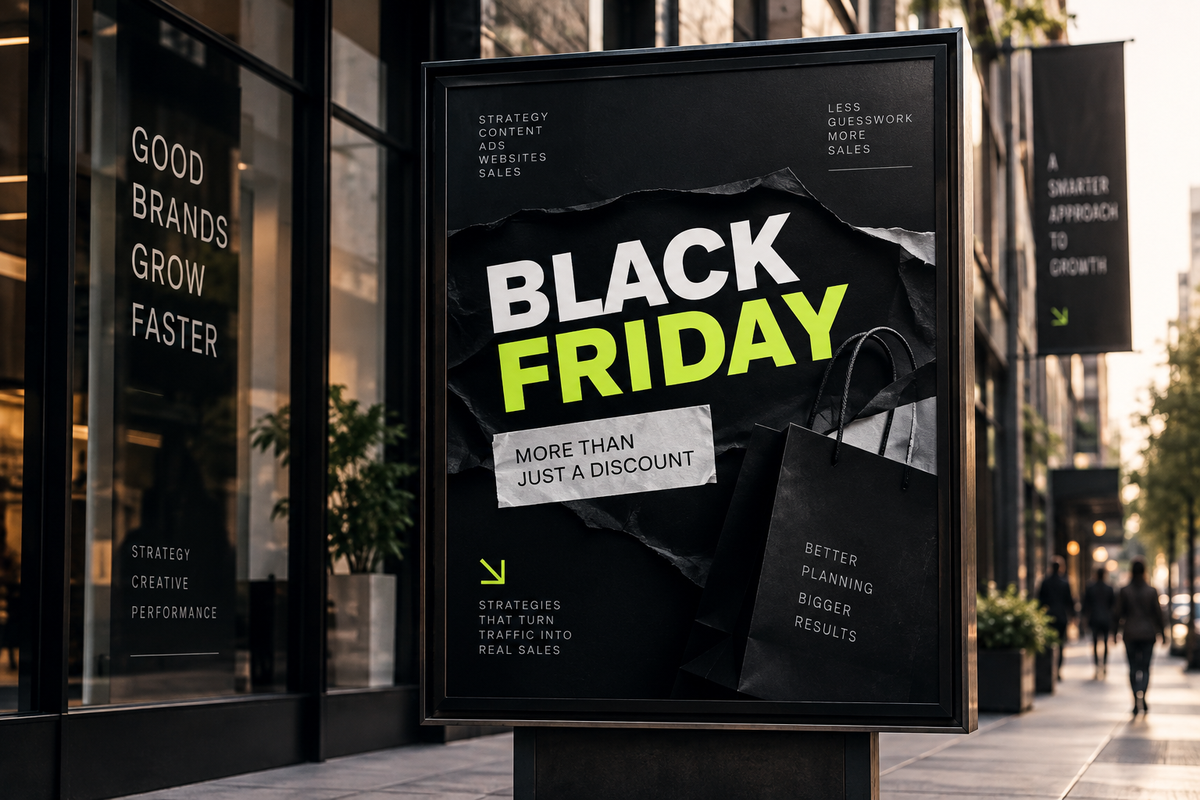
Black Friday is no longer just a date on the calendar—and it is certainly not merely an excuse to put up a big black “-30%” banner and wait for sales to pour in. For many online stores and businesses, it is one of the strongest commercial periods of the year. At the same time, it is also one of the most competitive. Within just a few days, customers see dozens, and sometimes hundreds, of offers, ads, discount codes, countdowns and messages from different brands.
And that is where the real challenge begins. The question is no longer simply: “What discount should we offer?” It is: “How can we make customers choose us?” Because a successful Black Friday campaign does not start with the ad creative and does not end with the discount percentage.
It starts much earlier—with a well-planned offer, a clear objective, thorough audience preparation, content that generates interest, advertising aimed at different user groups and a website capable of turning that interest into an actual purchase. Then come email communications, retargeting, reminders, limited-time offers and a strategy for what happens to new customers after the campaign ends. Because Black Friday can bring a lot of traffic.It can generate impressive revenue.It may even bring you your strongest day of the year. But if the campaign is created without careful calculation or a strategy, it can just as easily result in low margins, expensive advertising, an overloaded website and customers who buy once because of the discount and never return.
That is why a successful Black Friday is not a competition to see who can offer the biggest discount. It is a combination of a strong offer, the right communication, the right audience and a well-prepared digital system. In this article, we will look step by step at how to prepare your business for Black Friday—from choosing an offer and calculating the discount to content, advertising campaigns, your website, email marketing and post-purchase communication. So that you do not begin preparations with the question: “What percentage should we discount?” But with the more important one: “How do we want this campaign to work for our business?”

Start with an objective, not a percentage
One of the most common mistakes when preparing for Black Friday is for a business to start directly with the question: “What percentage discount should we offer?” But a discount is only a tool. Before it, you need a clear objective. Because different objectives require different offers, different messaging and often a completely different advertising strategy.
If, for example, your main goal is to attract new customers, it may be wiser to offer a strong deal on a first order, free shipping or a specific bestseller at a better price instead of discounting your entire catalogue.
If the goal is higher revenue, a mechanism that encourages a higher order value may work better. For example:
“-10% on orders over €50”
“-20% over €100”
“-25% over €150”
If you have products you want to move, Black Friday can be a good opportunity to clear selected inventory. In this case, you do not necessarily need to discount everything. You can create a separate selection, bundle or special category featuring specific products. For a business that already has a strong customer base, the goal may be quite different—repeat purchases and loyalty. In that case, early access, a VIP offer, a special code for existing customers or a gift with the order can be much more powerful than a standard mass discount.
The same applies if you want to use Black Friday to grow your email list. Instead of revealing the entire offer right away, you can offer early sign-ups in advance: “Subscribe and get access to the Black Friday offers 24 hours early.” This way, the campaign does not just generate one-time sales—it builds an audience you can continue communicating with after the promotion ends. It is important to remember that the biggest discount is not always the best offer.
Sometimes customers will value the following more: a gift with the order; free shipping; a bundle at a better overall price; “Buy 2, get 3”; an additional bonus above a certain order value; an exclusive product; early access to the promotion.
A good Black Friday offer should be attractive enough for the customer while also working in the business’s favor. So before you write the big “-40%”, ask yourself a more important question: “What exactly do we want this campaign to change?” When the goal is clear, it becomes much easier to define the offer, budget, audience, content and how you will measure whether the campaign is truly successful.
Check the numbers before you hit Publish
Black Friday can bring record sales and almost no profit if the offer is created with just one thought in mind: “we have to offer a big discount.” The percentage looks good on an advertising banner, but on its own it says nothing about whether the campaign is actually successful for the business. Before deciding whether to offer -20%, -30% or -40%, work backwards. Start with the price the customer will pay and subtract everything that actually goes into making that sale: the product cost; the discount; packaging and shipping costs; transaction and platform fees; advertising spend; the average customer acquisition cost; any gift or free shipping; expected returned and refused orders. Because sales and profit are not the same thing.
You can have your strongest revenue day ever and still discover after the campaign that a large share of that revenue went to ad platforms, couriers and discounts. And the scale of Black Friday only makes these calculations more important.
Sales among Shopify merchants during Black Friday–Cyber Monday 2025 were 27% higher than the previous year.
This is the average basket value among Shopify merchants during BFCM 2025 — a good example of why average order value is a metric worth tracking.
The average global online cart abandonment rate is around 70%, according to Baymard’s summary of 50 different studies. In other words, driving traffic is only half the job.
Sources: Shopify BFCM 2025 and Baymard Institute. The data provides market context and is not a universal benchmark for every business.
These figures show something important: Black Friday brings enormous demand, but high traffic alone does not guarantee a strong financial result. That is why, alongside revenue, you should track several other metrics.
WANT YOUR BLACK FRIDAY CAMPAIGN TO DRIVE MORE THAN TRAFFIC?
Subscribe for practical marketing strategies, checklists and ideas you can apply directly to your business.
What is your average order value? If customers typically spend €45, it may be smarter to encourage larger baskets rather than simply discounting every product. For example: Free shipping on orders over €60. or A gift with orders over €80. This gives the customer extra value while also encouraging a higher order value.
How much can you afford to pay for one new customer? This is another calculation that often gets overlooked. Let’s assume that after all costs and the Black Friday discount, you have €15 in margin left from one order. If advertising costs you €18 to acquire that customer, the campaign looks very different — regardless of how impressive the overall reach or revenue in Ads Manager may be. That is why you should define in advance the maximum customer acquisition cost your business can afford. And leave room for change. During highly competitive periods, advertising costs can fluctuate, and a campaign that is profitable at one acquisition cost may stop being profitable at another.
Don’t discount everything out of habit If the numbers show that “-40% off everything” does not work for your business, that does not mean you lack a strong enough Black Friday offer. Sometimes these options make much more sense: bundle offers; discounts on selected categories only; a gift with the order; free shipping above a certain order value; an additional bonus for a larger basket; a special offer for existing customers only.
A good Black Friday campaign is not the one with the biggest number on the banner.
It is the one where the customer sees a good enough reason to buy, while the business still has a good enough reason to sell.
So before reducing the price, check what remains after the discount.
The goal is not simply to generate more orders.
The goal is for those orders to make business sense.
Prepare your audience in advance
One of the most common Black Friday mistakes is for a business to stay silent until the last minute and suddenly appear on the day of the campaign with: “30% OFF TODAY ONLY!” The problem is that, for part of your audience, this is the first time they see the offer—and sometimes even the first time they pay any attention to the brand. People rarely go directly from “I’m seeing this for the first time” to “I’m buying it right away.” That’s why preparation needs to start before Black Friday itself. The goal is to gradually build interest and anticipation, and give people a reason to follow what’s coming.
Start with teaser content
You don’t need to reveal the entire offer right away.
Sometimes it’s enough to say:
“Something’s coming.”
“We’re getting ready for our biggest campaign of the year.”
“Save the date.”
This creates the first level of interest and begins mentally preparing your audience to make a purchase.
You can then gradually reveal more.
For example:
which categories will be included;
which products will be part of the offer;
whether quantities will be limited;
whether there will be a gift;
whether there will be special bundle offers;
how long the campaign will last.
Instead of a single communication moment, you create an entire series of touchpoints.
Give people a reason to sign up in advance
Black Friday is a great opportunity to grow your email list. Instead of simply saying: “Stay tuned.” you can give people a specific reason: “Sign up and get access to the offers 24 hours early.” or: “Email subscribers will get access to a special Black Friday selection before everyone else.” This turns curiosity into a real contact you can communicate with directly. Most importantly, that contact remains yours after the campaign ends.
Use early access
Early access works especially well for: current customers; loyal customers; VIP segments; email subscribers; people who have already purchased from a specific category. This creates a sense of exclusivity and gives people a real reason to open the email or return to the website. Instead of everyone seeing the same offer at the same time, part of your audience gets an advantage.
Prepare your content too
Before the launch, don’t publish only promotional visuals. Use this period for content that helps people make a decision. For example: “Which product is right for you?” “Our 5 best-selling products” “What’s the difference between X and Y?” “How to choose the right option?” customer reviews; UGC; demonstrations; frequently asked questions. That way, when the discount begins, the customer already knows what they want. All they need is a good enough reason to buy it right now.
Prepare your advertising audiences too
The period before Black Friday is also a good time to build a warmer audience. People who: have watched your videos; have interacted with your profile; have visited your website; have viewed a product; have added a product to their cart; are already customers. On Black Friday, these people aren’t seeing the brand for the first time. They already have some context. And that makes the next advertising message much more meaningful.
Increase urgency gradually
There’s no need to start shouting two weeks in advance: “LAST CHANCE!!!” Urgency should build naturally. First: “Coming soon.” Then: “Here’s what’s included.” After that: “Early access starts tomorrow.” Then: “Black Friday is live.” And finally: “Only a few hours left.” This gives your communication a rhythm and prevents you from exhausting your audience’s attention before the campaign even begins. On launch day, you don’t want to be speaking to a completely cold audience. You want to speak to people who already know something is coming, are familiar with part of the offer, are interested in specific products, and are simply waiting for the right moment.
The website is part of the campaign
You may have an excellent offer, strong advertising, and a well-prepared audience, but if your website isn’t ready to handle the traffic and turn interest into purchases, much of your effort may go to waste. Black Friday usually means more traffic, more simultaneous visits, and a much lower patience threshold among users. If the website loads slowly, the checkout process is confusing, or the promotion isn’t clear enough, customers won’t wait long. They’ll simply open the next store. That’s why the website shouldn’t be viewed merely as the place where advertising “sends people.” It is part of the campaign itself.
Start with the mobile version
Check the entire user experience on a phone, not just the homepage. Go through the process as a real customer: from the ad to the product page; from the product to the cart; from the cart to checkout; from checkout to order confirmation. Make sure the buttons are clearly visible, the text is easy to read, pop-up windows don’t interfere with navigation, and the most important information isn’t hidden below the fold. A website may look perfect on a large monitor, but shopping on a phone is an entirely different experience.
Speed matters
Black Friday is not the time for customers to wait for a product page to load. Heavy images, unnecessary scripts, too many pop-ups and unoptimized pages can slow down your site just when it is receiving the most traffic. Check in advance: the homepage speed; product pages; categories; the cart; the checkout process. The more steps there are between the ad and the purchase, the more opportunities you give customers to abandon their order.
The offer should be clear from the first visit
Don’t make users search for the promotion terms.
From the very first seconds, it should be clear:
What is the offer?
How long is it valid?
Which products does it apply to?
Is a promo code required?
Is there a minimum order value?
If there are exceptions, make them clear.
Black Friday is not the time for asterisks with terms buried at the bottom of the page.
Show the old and new prices clearly
Customers should immediately see exactly what they are getting.
Regular price.
Promotional price.
Discount amount.
No unnecessary calculations for the customer.
If the offer is activated with a promo code, this should also be clear and visible before checkout.
Check your stock levels
Nothing undermines a successful campaign faster than a product that is being actively advertised but is already out of stock.
If you have limited quantities, plan in advance how you will respond when they run out.
Will you hide the product?
Mark it as out of stock?
Offer an alternative?
These are small details that become very important when your site receives more traffic than usual.
Make the checkout process as easy as possible
The customer has already chosen a product and reached the cart. Don’t complicate the final step. Check that: the order can be completed easily; the forms don’t request unnecessary information; payment methods work; delivery is explained clearly; promo codes are applied correctly; the final price contains no unpleasant surprises. This is exactly where many purchases are lost. And if you pay for every visit generated by your ads, every unnecessarily complicated element in the checkout process can become a real cost.
Check your tracking before launch
Don’t wait until after Black Friday to discover that some purchases were not recorded correctly. Before the campaign, test: Meta Pixel; Google Analytics; Google Ads conversion tracking; Add to Cart; Begin Checkout; Purchase; purchase value; UTM parameters. Also place a real test order. If your tracking does not work correctly, you won’t know what actually generated your sales, making ad optimization much more difficult.
Prepare a landing page if the campaign requires one
Instead of sending every ad to the homepage, it can sometimes be much more effective to create a dedicated Black Friday page. You can bring together in one place: the strongest offers; participating categories; bestsellers; the campaign terms; frequently asked questions; clear calls to action. This reduces the number of decisions users have to make and guides them along a much clearer path to the offer.
Your website should take customers from interest to purchase.
Your content should drive action
During Black Friday, it is not enough simply to show that you have a discount. Users are already seeing dozens of similar offers. If every post says only: “30% off selected products” it will be very difficult to stand out. That is why content should have another purpose: helping customers understand what to choose, why to choose it and why to do so right now. The discount percentage alone may attract attention, but it is rarely enough to drive a purchase decision.
Don’t just show the product. Show the reason to buy
Instead of posting a product image with its price and discount, provide more context. Show what problem the product solves, who it is suitable for, when it is used and what real benefit it provides. The difference is between: “This product is 25% off.” and: “If you are looking for a solution to X, this product is one of our most suitable options—and this week it is 25% off.” The second statement does more than present the offer. It helps customers see themselves in it.
Help people choose
With a larger catalogue, Black Friday can become confusing.
Dozens of products.
Different discounts.
Different categories.
Instead of leaving customers to find their way around on their own, make the choice easier.
Content such as:
“3 products for…”
“Which option is right for you?”
“X vs. Y — what’s the difference?”
“Our Black Friday bestsellers”
can be much more useful than yet another promotional banner.
The less effort customers need to make a decision, the easier it is for them to complete a purchase.
Use social proof
During Black Friday, customers often discover products and brands they have never bought from before. That makes trust even more important. Reviews, UGC content, real customer photos and videos, demonstrations, and results can answer the question: “Okay, it’s discounted. But is it worth it?” This type of content can help someone who is already interested but still not ready to place an order.
Address objections before customers raise them
Instead of leaving every question for direct messages, use your content to answer them in advance. For example: How does delivery work? Can the product be returned? How long is the promotion valid? Are quantities limited? Is a code required? Can the offer be combined with another one? How do I choose the right size or option? An FAQ post or a series of Stories can remove the small doubts that might otherwise stop a purchase.
Create different content for each stage of the campaign
Not every post needs to say the same thing. Before the launch, the goal may be to build curiosity. At the start of the campaign — revealing the offer. In the middle — products, benefits, bestsellers, comparisons, and reviews. Towards the end — urgency and reminders. This way, your content follows customer behaviour instead of showing the same banner with a different product for seven days in a row.
Countdown and last-chance content have their moment
Urgency works when it is real.
If the offer ends at midnight, say so.
If a product is almost sold out, that can also be important information.
But if every post says:
“LAST CHANCE!”
“NOW ONLY!”
“HURRY!”
from day one, the effect gradually wears off.
The strongest sense of urgency comes towards the end of the campaign, when customers already know the offer and have a real reason not to delay their decision.
And don’t forget the call to action
Once you have shown the product, its benefits, and the offer, tell customers what the next step is.
Explore the Black Friday selection.
See all discounted products.
Choose your option.
Order before the campaign ends.
Your content should not simply look good in the feed.
It should move customers from:
“I saw it.”
to:
“I’m interested.”
and then to:
“I want it.”
and finally:
“I’m buying it.”
That is why effective Black Friday content is not a series of promotional banners.
It is part of the path to purchase.
PREPARING A BLACK FRIDAY CAMPAIGN? DON’T LEAVE IT UNTIL THE LAST MINUTE.
From strategy and the offer to advertising, content, and the path to purchase, we can help you structure your campaign as a complete system rather than just another promotion.
Contact usDon’t stop after Black Friday
One of the biggest mistakes is ending communication the moment the promotion ends.
The campaign ends.
The banners are removed.
The ads are switched off.
The orders are shipped.
And many businesses simply move on.
But that is precisely when one of the most valuable parts of Black Friday begins.
Because among all the orders placed, there are likely people who are buying from you for the first time.
You have already paid to capture their attention. You convinced them to visit your website, browse your products, trust you, and ultimately make a purchase.
Ending communication here means missing out on much of the value this campaign can generate.
Don’t focus only on the first sale
Black Friday often attracts customers with a compelling offer. But the real question is: Will these people come back when there’s no -30% discount? This is where customer retention and follow-up communication come in. The goal is not for the customer to remain in your records as: “order №4832” but to start giving them a reason to choose your brand again.
The first post-purchase message matters
Communication should not begin with the next promotion. Immediately after the order, you can create a positive experience through: clear purchase confirmation; delivery information; helpful product guidance; thanks for their trust; instructions or usage ideas. This may seem like a small detail, but these are precisely the moments that begin shaping how customers feel about the brand after the purchase.
Use welcome communication for new customers
If Black Friday has brought you many new customers, don’t add them straight to your general list and wait for the next mass promotional message.
Create a short sequence to introduce them to your business more effectively.
For example:
Email 1: Thank you for your order.
Email 2: How to get the most out of your product.
Email 3: More products that may be right for you.
Email 4: The brand’s story or values.
Email 5: An offer for your next purchase.
This way, communication gradually moves from:
“I bought because it was Black Friday.”
to:
“I know this brand and would buy from it again.”
Use the information from the first purchase
Not every customer should receive the same offer. If someone has purchased a specific product or from a particular category, your next communication can be tailored to that exact interest. You could offer: a complementary product; refill or repeat purchase; a product from the same range; an upgrade; a bundle; a personalized recommendation. This is far more relevant than a generic: “We have new products. Take a look.”
Don’t rush into another discount
If a customer came to you because of Black Friday, you don’t need to immediately teach them that the only reason to buy from you is the next discount.
After the campaign, show them other reasons to stay.
Quality.
Service.
Useful content.
Expertise.
Community.
A great customer experience.
Otherwise, you risk building an audience that only responds when it sees a red price tag with a percentage.
Analyze what actually happened
Black Friday doesn’t end from a data perspective either. After the campaign ends, analyze: which ads generated the most sales; which products performed best; which audiences converted; what the average order value was; what the customer acquisition cost was; how many carts were abandoned; which email campaigns generated revenue; where users dropped off; how many customers were new and how many were existing. Don’t look only at total revenue. This data can show you what to repeat, what to stop and what to improve in your next major campaign.
Black Friday can be a beginning, not an end
The most valuable Black Friday customer isn’t necessarily the one with the largest order.
It may be the person who makes their first purchase in November and then comes back in January, March and June.
That’s the difference between a one-time promotion and a growth strategy.
So don’t measure Black Friday success solely by how much you sold over a few days.
Look at what you built afterward, too.
How many new customers did you acquire?
How many of them came back?
How many remained on your email list?
How many continued engaging with the brand?
Black Friday isn’t won with the loudest banner or the biggest discount.
It’s won with good preparation, a clear offer, the right audience, an optimized path to purchase and a system that keeps working even after Black Friday is over.
Because a truly successful campaign doesn’t end with:
“Your order is complete.”
It begins afterward.
When is the best time to start preparing for Black Friday?
It’s best to start preparing at least a few weeks in advance. This gives you time to plan the offer, advertising audiences, content, email communications, landing page and tracking. The earlier you prepare your audience, the less you depend on winning their attention on the day itself.
Do we need to discount all products for Black Friday?
No. A sitewide discount isn’t necessarily the best strategy. You could choose specific categories, bestsellers, bundle offers, a gift with purchase, free shipping or a higher discount for larger basket values. The most important thing is for the offer to be attractive to the customer and profitable for the business.
How can we tell whether our Black Friday campaign was successful?
Don’t look only at revenue. Track profit, average order value, customer acquisition cost, conversion rate, ROAS, the number of new customers and how many of them return after the campaign. A successful Black Friday campaign doesn’t just generate more orders—it delivers measurable value after the promotion ends as well.