
Google now allows websites to directly invite their readers to add them as a Preferred Source in Search. The new interactive button reduces the process to just a few steps and brings an important part of the relationship between a website and its audience directly into the Google ecosystem.
This is a significant change because, until now, a website’s primary task was to convince algorithms that its content deserved visibility. Now there is another layer: people themselves can explicitly tell Google which sources they prefer.
And this is exactly where Google Preferred Sources, preferred sources in Google, Make me preferred on Google, and the new Google Preferred Sources button start to matter far more than just another minor Search feature.
Google has officially announced that publishers can now embed an interactive Preferred Sources button on their own pages. When readers use it, they can add the site as a preferred source and then be taken back to the page they were reading. At the time of the announcement, users had already selected more than 600,000 unique sources.
The feature does not mean that a website automatically receives a higher ranking for everyone. It allows an individual user to specify which sources they prefer, and Google to use that preference when personalizing their Search experience.
This distinction is important from the outset.
If someone adds a website as a Preferred Source, it does not automatically follow that the site will start outranking its competitors for all other users. This is not a new shortcut to position No. 1, nor is it a replacement for technical SEO, content quality, topical relevance, or the other signals Google uses.
It is about something different: a real person’s preference for a specific source.
And that is interesting because it creates a link between SEO acquisition and audience retention. A good article is no longer necessarily just an opportunity to win a visit. It can also be the moment when a reader decides they want to encounter that source again.
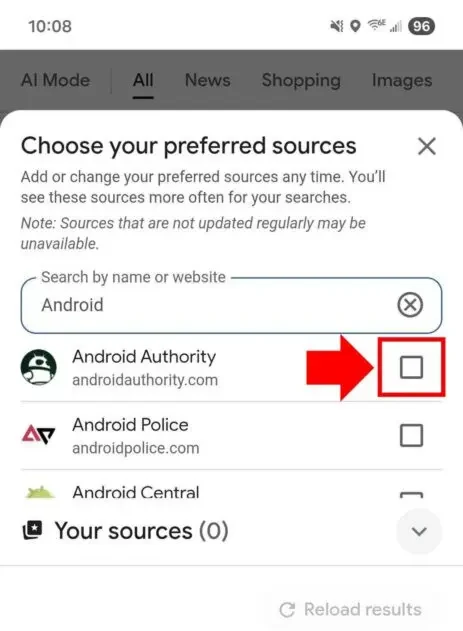
What exactly are preferred sources in Google?
Preferred Sources is part of Google Search personalization. Users can choose the websites they find useful or trustworthy, or simply prefer to follow. When Google subsequently has fresh and relevant content from these websites, it may be displayed more prominently for that particular person.
In Top Stories, selected sites may appear more often when they have up-to-date content related to the search topic. Google may also use a separate From your sources section, without removing other publishers from the results.
Search Central’s official documentation describes the effect carefully: when a user selects a site as a preferred source, its content is more likely to appear in Top Stories and may be marked with a Preferred label.
This is very different from a model in which someone “locks” Search to just a few sites. Other sources continue to appear. Preferred Sources simply allows Google to understand that, for a particular person, certain publications have greater personal value. Google initially launched the feature in the US and India in August 2025, then gradually expanded it. On April 30, 2026, the company announced a global expansion for Top Stories across all languages in which Google Search is available.
What happens after selecting a Preferred Source?
When a site is selected, Google may use that preference for future relevant searches. If the publication has suitable and sufficiently up-to-date content, the user may see it more prominently in Top Stories or other supported Search surfaces. There is another important detail here: it is not enough for the site simply to exist.
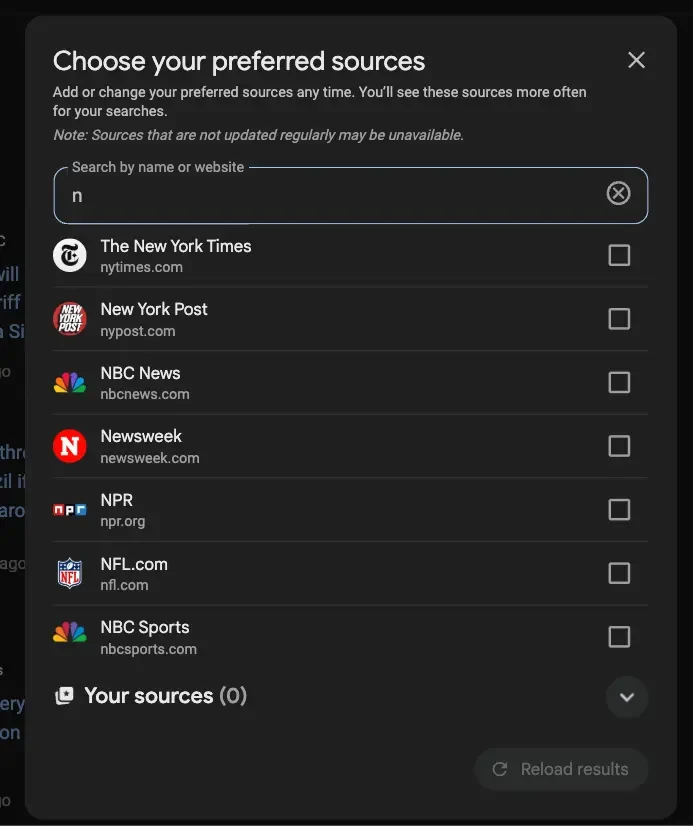
Google Search Help warns that sources which are not updated regularly may not be available for selection. This makes sense—the feature is built around the idea of following sources that have something new to offer. For a business blog, this means the button makes far more sense as part of a genuine editorial strategy than as a decorative element on a site that publishes one article a year.
Why is Google Preferred Sources interesting for SEO?
SEO traditionally starts with a question like: “How do we make this page good enough to be found?”
“What happens after the person has already found us?”
This is a much more important shift in thinking than it may seem. A site may earn impressions and clicks, yet every new visitor behaves like a complete stranger. They arrive, read something, close the page, and the next time they search, you are competing for their attention from scratch once again.
Strong content brands work differently. After several quality interactions, users recognize the name, style, author, or domain. When results are equally relevant, they may consciously choose the familiar source. Google Preferred Sources makes part of this relationship explicit.
A strong SEO article should do more than win a click.
This does not make ranking irrelevant. Quite the opposite.
First, the content has to reach the right person in the first place. The technical foundation must be solid, Search intent must be understood, the page must be high-quality and useful enough, and Google must be able to discover and process it. After that, however, the other half of the work begins: will the person remember the site? As Google Search becomes increasingly personalized, the ability to build a recognizable source, rather than simply a collection of optimized URLs, becomes increasingly valuable. That is precisely why Preferred Sources intersects with SEO, brand building, UX, and content marketing.
Make me preferred on Google: what changed in August 2026?
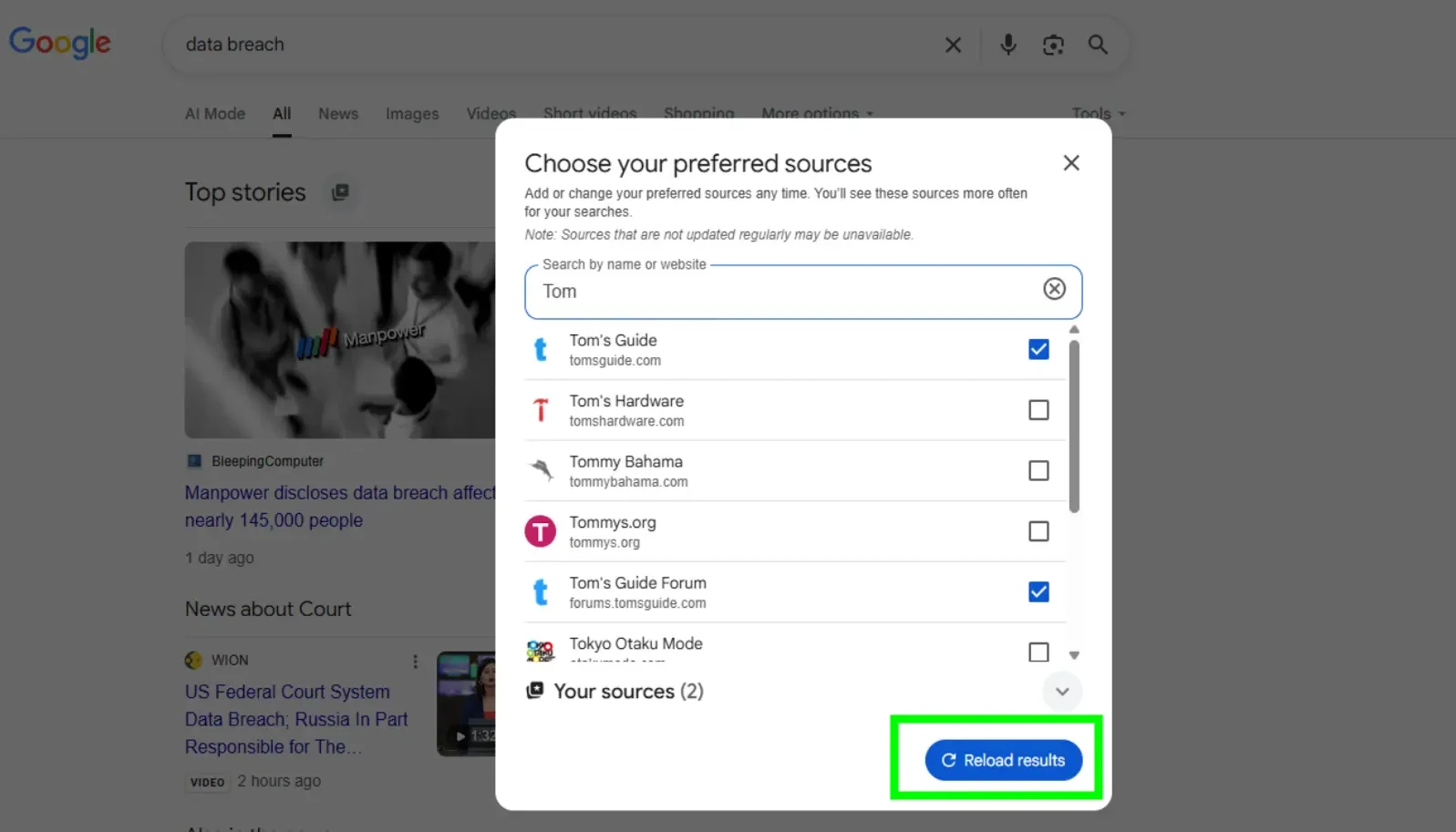
The Preferred Sources feature itself is not new as of August 2026. What is new is that Google is significantly reducing the friction between websites and Source Preferences. Search Central has added official instructions for a custom interactive button that publishers can place directly on their own pages.
This matters because, until then, a reader might have liked a publication but would have had to know about Preferred Sources, open Settings, find Source Preferences, search for the site, and select it. That is too many steps for most people. With the new Google Preferred Sources button, the publisher can offer the action precisely when the reader has already received value from the content.
That is precisely the thinking behind Make me preferred on Google. Imagine someone who has reached the middle or end of a detailed analysis. They have already invested time, found useful information, and have a specific reason to remember the publication.
“Like this kind of analysis? Add us as a Preferred Source in Google.”
After clicking the interactive Google flow, the user can add the site and then return to the page they were reading. This seamless return is one of the reasons Google recommends the standard JavaScript implementation.

What does the process look like for the reader?
From the user’s perspective, the process can feel very natural. They do not have to start in Google settings or know in advance how Source Preferences works. The site can suggest the action in a context where it already makes sense.
- the reader comes across a useful article;
- they read enough of the content to assess the source;
- they see an unobtrusive Preferred Sources CTA;
- they click the Google Preferred Sources button;
- they add the site as a preferred source;
- Google completes the flow and returns them to the page;
- for future relevant searches, their preference can now be used in supported Search experiences.
This is significantly different from simply clicking through to an external setting. The publisher can now place the action within its own editorial journey and choose when to present it. The strongest moment probably will not be the hero section. If someone has just arrived on the site, they have no reason yet to designate it as a preferred source. It makes more sense to demonstrate value first. Content → trust → recognition → preference.
How do you add a Google Preferred Sources button to a website?
Google offers a standard JavaScript implementation, which the company itself recommends as the best option for user experience. The integration is minimal: load Google’s publisher library and add the button container wherever you want it on the page.
These are the two main approaches described in the official Google Search Central documentation for Preferred Sources.
The standard option automatically renders a Google-styled button and can be localized to the user’s language. Google also allows you to choose a light or dark theme, and, if necessary, set the language explicitly.
For sites with their own component system, there is also an advanced JavaScript implementation that allows the Preferred Sources flow to be launched programmatically from custom UI. This provides more flexibility when the button needs to be part of a sticky element, custom article widget, or another branded interface.
Google also offers a deeplink option for sites that cannot or do not want to load the JavaScript integration. Such a link can also be used outside the site—for example, in a newsletter, social campaign, or another communication channel. However, there is one important practical difference here.
On the article page itself, the standard interactive button provides a smoother flow, and Google explicitly identifies it as the recommended implementation. The deeplink is a useful alternative, but there is no need to complicate the article with separate CODE blocks for every example URL.
Google determines eligibility at the domain or subdomain level. A main site can be a source. An individual subdomain can also be a source.But a directory such as /blog is not treated as an independent Preferred Source.
Before integration, you should check whether the site appears in Source Preferences
This is one of the most important practical details.
Search Central recommends first looking for the site in the Source Preferences tool. If the publication does not appear there, aggressively promoting the CTA to your audience is unlikely to be worthwhile. The fact that a site is indexed by Google does not automatically mean that it will appear as a Preferred Source at any given time.
Google Search Help states that sources that are not updated regularly may become unavailable. That is why Preferred Sources is particularly relevant for sites that maintain a genuinely active publishing rhythm.
Get the next important updates directly by email
Practical analysis of SEO, Google Search, AI, and digital growth—with context on what is really changing and what is worth implementing.
Google Preferred Sources is now also coming to AI Overviews and AI Mode
Preferred Sources is no longer limited to Top Stories.
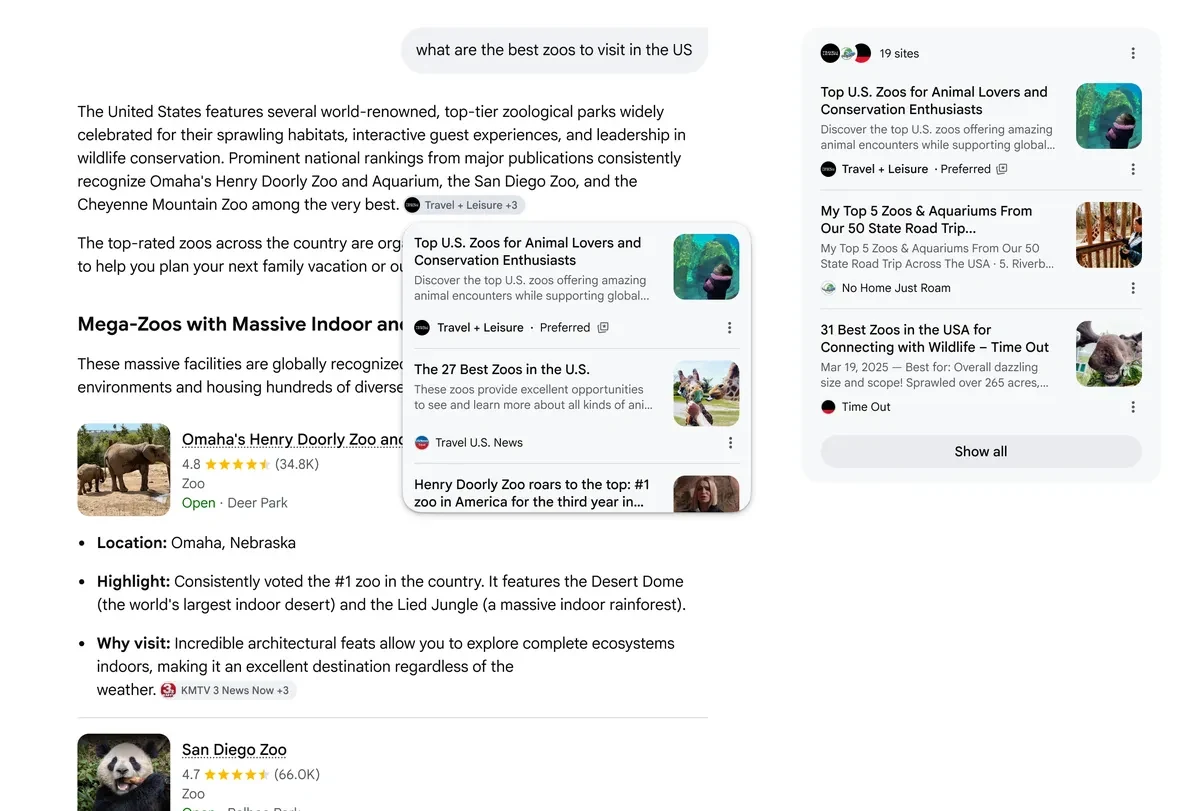
On May 27, 2026, Google announced an expansion of the feature to AI Overviews and AI Mode. In these experiences, links from sites a person has already selected can be marked with a Preferred label, making them easier to identify among other sources. This is particularly interesting for publishers, because the way people consume Search results is gradually changing.
In the classic SERP, individual links are the page’s primary structure. In AI Overviews and AI Mode, Google may first present a synthesized answer and display links, cards, and other sources around it. In this environment, recognizing a specific publisher becomes even more important.
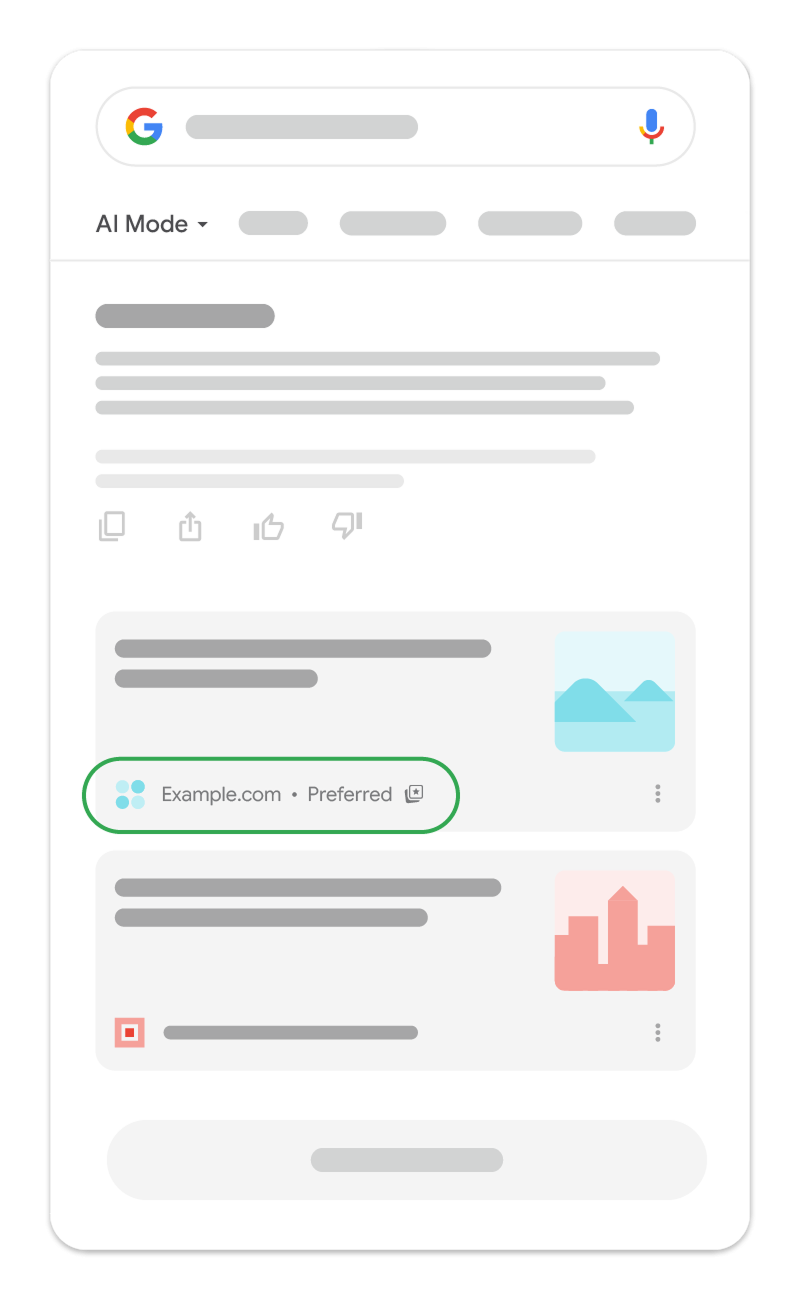
Again, it is important not to jump from a fact to a promise Google has not made. The Preferred label does not mean that a site will automatically appear in every AI Overview. It does not mean that a single preference click guarantees a citation in AI Mode. And it does not mean that standard SEO principles disappear.
The content still needs to be relevant to the query and appear on the appropriate Search surface. But when a site is already part of the result, Google has a mechanism for showing users that it is one of the sources they themselves have preferred. This detail may seem minor, but in an interface with dozens of potential sources, visual recognition matters.
How does Preferred Sources change the way we should think about content strategy?
If a website wants people to choose it as a Preferred Source, it needs to give them a reason to do so. This is where the feature becomes far more interesting than the button itself.
A single SEO article can attract someone through a specific query. But why would they want to see more content from the same domain? The answer is rarely “because the article has a well-optimized title.”
The reason is more likely to be a combination of usefulness, originality, editorial consistency, expertise, visual quality, and the sense that the publication has its own point of view. In other words, Preferred Sources rewards not only the ability to be found, but also the ability to be preferred.
This places a new focus on editorial consistency. If the first article is a detailed analysis, the second is a superficial AI rewrite, the third has no author, and the fourth looks like it belongs to an entirely different website, it becomes difficult to give people a reason to follow the publication as a source. A strong content hub needs a recognizable structure. The topics can vary, but the standard should not be arbitrary. And this is where Preferred Sources meets the concept of topical authority in a very human way: not simply having Google associate the site with a particular subject, but having real readers associate it with that subject.
- Choose topics where you can add your own analysis, rather than simply retelling what others have published.
- Publish regularly enough to give your returning audience something new to discover.
- Build clear topical connections between individual articles.
- Use contextual internal links to turn one article into an entry point to a larger content ecosystem.
- Maintain a recognizable editorial design and a clear author identity.
- Place the Preferred Sources CTA after delivering value, not before readers have a reason to trust you.
- Combine Google preference with a newsletter, related articles, and other audience-retention mechanisms.
At Trendcodd, this model makes the most sense for content that analyzes real changes in SEO, websites, advertising, analytics, and automation. Someone who has discovered one useful article should be able to easily continue to other related materials in Trendcodd Blog. This way, an article does not remain an isolated page but becomes part of a larger content system that gives readers a reason to return.
Google’s data shows why the preference signal should not be underestimated
Google has already published several interesting figures on the feature’s growth. In April 2026, when Preferred Sources was expanded to all supported languages, the company reported more than 200,000 unique selected sites. On May 27, when it was expanded to AI Overviews and AI Mode, the figure had risen to more than 345,000. With the launch of the new publisher button, Google reported that users had already selected more than 600,000 unique sources. This does not prove that every publisher will see a significant traffic uplift. But it does show that the feature has not remained a forgotten Labs experiment.
The statistics on click behavior are even more interesting.
Google states that after someone selects a website as a Preferred Source, they are more than twice as likely to click through to it. This figure should be interpreted carefully.
It does not mean:
It describes the aggregate behavior of users who have already expressed a preference for the source. The cause-and-effect relationship may be far more complex: people choose websites they already like and are naturally more likely to click through to them later.
This is Google’s observation of the behavior of users who have already selected a given source. The statistic shows the strength of preference, not a guaranteed result for every website.
Where does it make sense to place the Google Preferred Sources button?
The fact that the button can be added almost anywhere does not mean it should appear everywhere. On an editorial site, its placement should follow the same logic we use for any other CTA: the action should be requested when the user understands why it is worthwhile. The hero section is often too early.
The person has just opened the page. The headline may look interesting, but they have not yet received anything from the site. Greeting them immediately with “Add us as a Preferred Source” is like a store asking for a review before the customer has received the product. A much stronger option is to place the button after an important section in a long-form article or near the end of the piece.
At that point, the CTA can draw on an actual experience:“Did you find this analysis useful? Add Trendcodd as a Preferred Source in Google to find our next articles more easily.”
Longer publications can also include a second placement near the related articles. This allows for several natural next steps: the reader can open another article, subscribe, save the source in Google, or move on to a specific service.
The best time to ask for a preference
The CTA does not need to be aggressive. Preferred Sources is closer to a “Follow” or “Subscribe” mechanism than to a performance banner. That is why good UX will likely be more understated: a brief explanation, a Google button, and a clear reason why the action benefits the reader. This is also the approach that could be used for a future integration on the Trendcodd article pages themselves, rather than mechanically placing the button on every page of the site.
How can we measure the Preferred Sources CTA without making up results?
From an analytics perspective, one distinction is especially important: a click on the button and successfully adding a source as a Preferred Source are not the same event. The site itself can easily measure interaction with the CTA. For example, a GA4 event can be sent on click with parameters for article, position, and device. We can then analyze whether the button performs better in the middle of the article, at the end, or in another position. This already provides useful data.
- how many readers saw the Preferred Sources CTA;
- how many interacted with it;
- which article category generates the most clicks;
- whether returning visitors use the button more often than new users;
- which position on the page performs best;
- how the interaction rate changes in relation to scroll depth and engagement.
However, we should not automatically turn these clicks into a figure such as:“437 people added us as a Preferred Source.”
If the analytics system has measured only clicks on the CTA, the accurate name for the metric would be, for example, Preferred Source CTA clicks or Preferred Sources flow starts. The public Google Search Central documentation describes the different ways to start the flow, but publisher analytics should remain limited to the events we can actually observe. It is a small detail, but an important one for reliable measurement.
Which sites have the greatest potential from Preferred Sources?
The most obvious use case is news and editorial publications, because Top Stories is a natural part of their traffic mix and they publish frequently enough. But the feature is not relevant only to traditional media. Niche blogs, expert publications, SaaS companies with active resource centers, e-commerce brands with a genuine editorial strategy, and service businesses investing in thought leadership can also build a publication that people want to follow. The critical factor is not the size of the site. It is whether there is a genuine reason for users to expect new, useful content from it.
For a small niche site, this preference may be especially valuable. Major media outlets already have brand recognition. A small specialist publisher may not have the same reach, but if it owns a specific niche and people see it as one of the best sources in that field, Preferred Sources creates another way to leverage that trust. Google itself gives examples spanning a wide range of sources—from local blogs to major global news organizations.
The stronger question is:“What specific topic can we become the source people consciously choose?”
What does this mean for the future of SEO?
Preferred Sources is just one feature and should not be turned into a theory that Google has suddenly changed the entire Search system. But it fits into a broader trend. Search is becoming more personalized. AI Mode is changing how sources are presented. AI Overviews synthesize information. Google continues to add mechanisms for showcasing original reporting, firsthand perspectives, and content from sources users already value. This makes source identity increasingly important.
In traditional SEO, we often think in terms of URL versus URL. One page competes with another. But real people do not always experience Search so mechanically. They see site names. They remember which publications have helped them before. They recognize authors. They recognize visual style. Over time, they build their own hierarchy of trust. Preferred Sources simply gives this behavior an interface. Users can now say directly: “This source matters to me.”
The strongest strategy is one where the two work together.
This is especially important for sites that rely on long-form educational content. If someone finds you through a useful article, the next goal should not simply be to send them back to Google. You can direct them to a related publication. You can offer them a newsletter. You can invite them to add you as a Preferred Source. This way, SEO traffic stops being a collection of isolated sessions and starts becoming a relationship funnel.
Want an SEO and content strategy that works as a system?
Connect SEO, content, and user experience in one cohesive strategy that does not end with the first click from Google.
Contact usA practical plan for a site that wants to use Preferred Sources correctly
Before implementation, it makes sense to first check whether the site is actually available in Source Preferences. Next, select the pages where the CTA has real context. For a site with an active blog, I would start with the strongest evergreen and news-driven articles rather than every page at once. The next step is positioning. Instead of placing the button above the fold, it is better to test it after enough editorial content, once the user has already received value. Then comes the analytics layer—click tracking, position, article category, device, and returning/new visitor context.
- Check whether the domain appears in Google Source Preferences.
- Choose the pages with the strongest editorial value.
- Add the standard Google interactive button.
- Place the CTA after sufficient content rather than automatically in the hero section.
- Add a clear explanation of why someone would want to choose the site.
- Measure CTA clicks separately from presumed confirmed additions.
- Compare different placements and article categories.
- Monitor whether the content hub maintains a consistent publishing rhythm.
- Improve internal linking so that Preferred Sources becomes part of a broader retention strategy.
This sequence is much healthier than simply adding the button and waiting for an “SEO uplift.” The button itself does not give anyone a reason to prefer the site. It only makes taking action easier once that reason already exists.
Google Preferred Sources FAQ
Is Google Preferred Sources a new SEO ranking factor?
No. Preferred Sources is a personalization feature. When a specific user selects a site, its content may be shown more prominently to that person in supported Search experiences. Google does not describe the feature as a universal ranking boost for all users.
What does “preferred sources in Google” mean?
These are sites that a user has personally selected in Source Preferences. When the content is relevant and up to date, Google may give them more prominent visibility in Top Stories, while in AI Mode and AI Overviews they may be labeled as Preferred.
What is Make me preferred on Google?
This is the publisher-side mechanism through which a site actively invites readers to add it as a Preferred Source. In August 2026, Google introduced a new interactive button for this flow.
Can any site use the Google Preferred Sources button?
A site owner can use the implementation options provided by Google, but it is sensible to first check whether the site actually appears in Source Preferences. Google also notes that sources that are not updated regularly may not be available.
Can a separate blog directory be a Preferred Source?
No. Google Search Central states that eligibility is determined at the domain and subdomain levels. A separate subdirectory is not treated as an independent source.
Does Preferred Sources work in AI Overviews and AI Mode?
Yes. Google began expanding the feature to AI Overviews and AI Mode in May 2026. Preferred content may be visually labeled for users who have already selected the relevant site. Availability also depends on where the AI Search features themselves are accessible.
How many Preferred Sources can a user select?
Google allows users to select multiple sources. During the initial rollout, the company stated that more than half of early Labs users had selected four or more sources.
Does Google guarantee more traffic after a site is selected?
No. Google reports that users are more than twice as likely to click through to a website after marking it as a Preferred Source, but this is an aggregate observation, not a promise of a specific traffic uplift for every publisher.
Where is the best place to position the Preferred Sources CTA?
The most logical placement is where the reader has already gained value from the content — for example, after a key section of a long-form article or near the end. The button has much stronger context after trust has been established than immediately when the page first loads.
Google Preferred Sources is more interesting as an audience tool than as an SEO trick
It is easy to reduce this change to just another Google button. But that misses the most interesting part. Preferred Sources creates a direct link between content quality, publisher recognition, and the future Search experience of a specific person. First, people need to find you. Then you need to earn the click. After that, you need to provide enough value for the source to be remembered. Only then does it make sense to ask for a preference.
That is precisely why I would not view Google Preferred Sources as a replacement for SEO. Rather, it is another reason SEO should be connected to a genuine content strategy. If an article was created solely for algorithm visibility, Preferred Sources cannot magically turn it into a publication people want to follow. But if a site already creates content that people return to, the new button removes some of the friction between that trust and Google Search.
Don’t optimize content for the button.
As of August 20, 2026, users had already selected more than 600,000 unique sources, and Preferred Sources appears not only in Top Stories but also as part of the evolution of AI Overviews and AI Mode. This is not a reason to place an aggressive popup on every page. It is not a reason to promise “2x SEO.” And it is not a reason to build a new industry around an invented “Preferred Sources optimization score.” But it is a good enough reason for publishers, business blogs, and sites with a genuine editorial strategy to pay attention.
Because in Search, where the algorithm is becoming increasingly complex, one of the strongest positions remains remarkably simple:
for people themselves to say that they prefer your site.
For the latest technical requirements and implementation options, the most reliable source remains the official Google Search Central documentation.